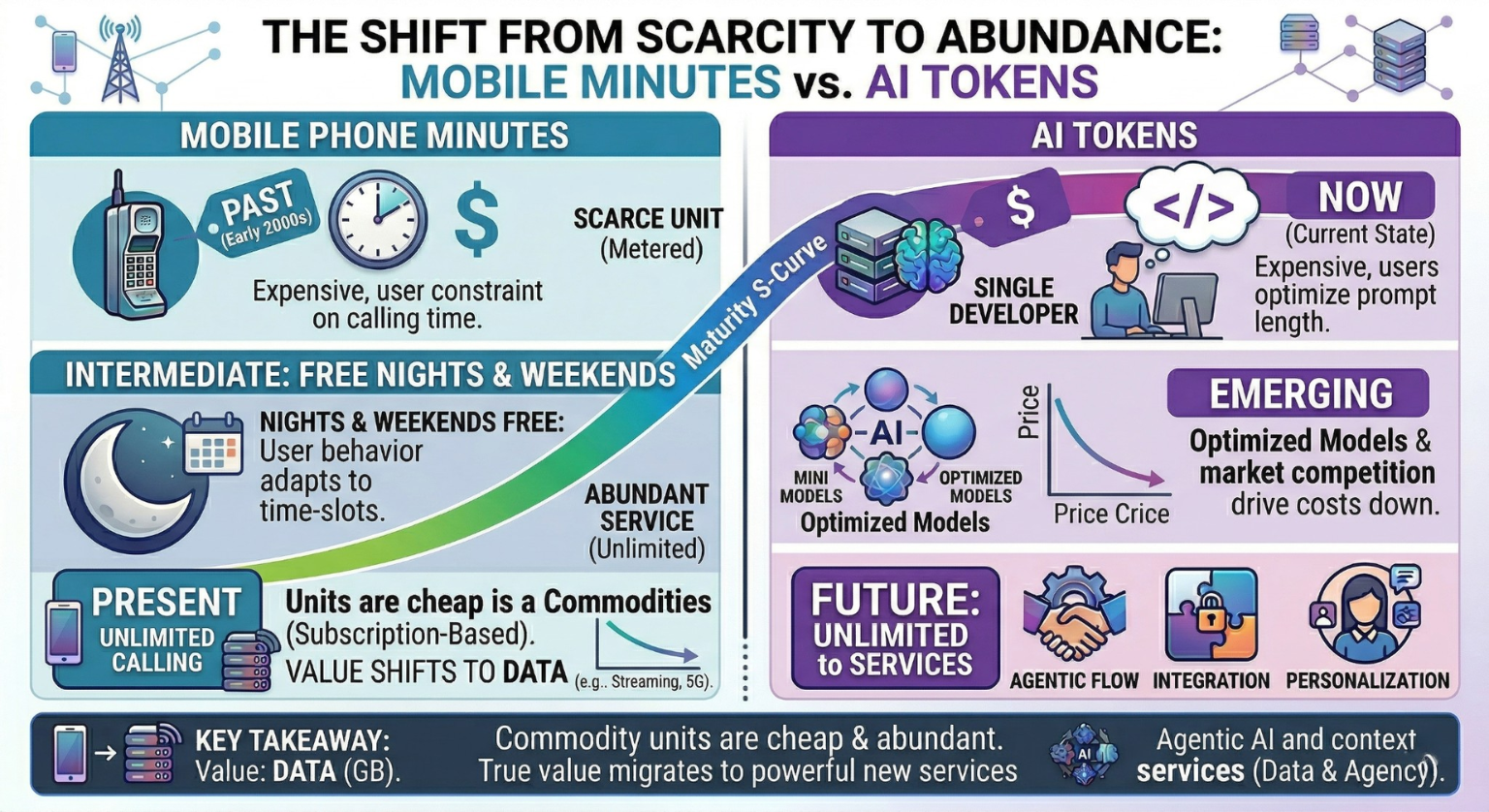
The Commodity Trap:Why AI Tokens are the New Mobile Minutes
Introduction
In the late 1990s, the "Mobile Minute" was a high-value currency. People checked their watches before making calls, waited until 9:00 PM for "free nights," and lived in fear of overage charges. Today, voice minutes are an invisible, unlimited commodity.
We are currently watching the exact same lifecycle play out with AI Tokens. If you want to know where the AI industry is going, don't look at sci-fi—look at the history of US telecom carriers.
The Lifecycle of a Commodity
1. The Scarcity Phase (The Metered Era)
Early cell carriers (AT&T, Verizon, Sprint) had massive CapEx costs. To recoup them, they charged per minute. AI started here in 2022. GPT-3 and early API access were billed strictly by the token. This phase is characterized by users optimizing every prompt to save "cents."
2. The Psychological Abundance Phase (The Bundling Era)
When competition arrived, carriers couldn't lower the minute price to zero immediately, so they created "bundles."
Nights and Weekends: Encouraged usage during off-peak times.
Friends and Family: Created a "network effect" (lock-in).
Roll-over Minutes: Reduced the pain of "wasted" value.
In AI, we see this with ChatGPT Plus ($20/month for "unlimited-ish" usage) and "free tiers" for off-peak models. We are currently in the thick of the Bundling Era.
3. The Unlimited Era (The Pivot to Data)
Eventually, the marginal cost of a minute became so low that billing for it was more expensive than the minute itself. Carriers shifted to "Unlimited Talk & Text."
The Question: If minutes were free, how did they make money? The Answer: They moved up the stack. They stopped being "voice companies" and became "data companies." They monetized the App Store, streaming services, and device financing.
What This Means for AI Providers
AI tokens are heading toward zero. "Intelligence" is becoming a utility like electricity or dial tones. To survive, AI companies must pivot exactly like the telcos did:
From "Tokens" to "Workflows": Don't sell the prompt; sell the completed task (The "Agent" model).
Ecosystem Lock-in: Just as carriers used "Family Plans," AI providers will use "Enterprise Integrations." Once your whole company’s data is synced to one model's memory, the "cost per token" is irrelevant.
The "App Store" Moment: The value isn't in the model; it's in the specialized applications built on top of it.
Conclusion
The winners in the AI race won't be the ones with the cheapest tokens. They will be the ones who realize that tokens are just the "minutes" of the 21st century—a commodity meant to be given away to sell something much more valuable: the platform.