The Selector Bottleneck: What Evolution Teaches Us About AI That Improves Itself
AI is already helping build the next version of AI.
As of May 2026, Anthropic reports that more than 80% of the code it merges is written by Claude. Google DeepMind's AlphaEvolve sped up a key piece of Gemini's code by 23%, cutting training time for the very models it runs on.
So the question is no longer "Can AI improve itself?"
It's "Who decides what counts as better?"
Claude and I wrote a white paper that answers it using the oldest self-improving system we know: evolution.
Evolution Never Needed a Judge
Evolution runs on three ingredients:
Variation. Selection. Heredity.
Individuals differ. Some differences help them survive. The winners pass their traits on.
Nobody designs the test. The environment does the judging, for free.
AI Breaks Three Rules
Self-improving AI has the same ingredients, but it rewrites all three.
Variation is directed. AI doesn't mutate at random. It proposes changes based on everything it knows.
Inheritance is Lamarckian. What a model learns today can be trained straight into tomorrow's version.
Fitness is designed. Nature never states an objective. AI systems do: tests, benchmarks, reviewers.
Each change makes AI evolve faster than anything in nature.
Together, they move the bottleneck.
The Bottleneck Moved
In nature, variation is expensive and selection is free.
In AI, it's flipped.
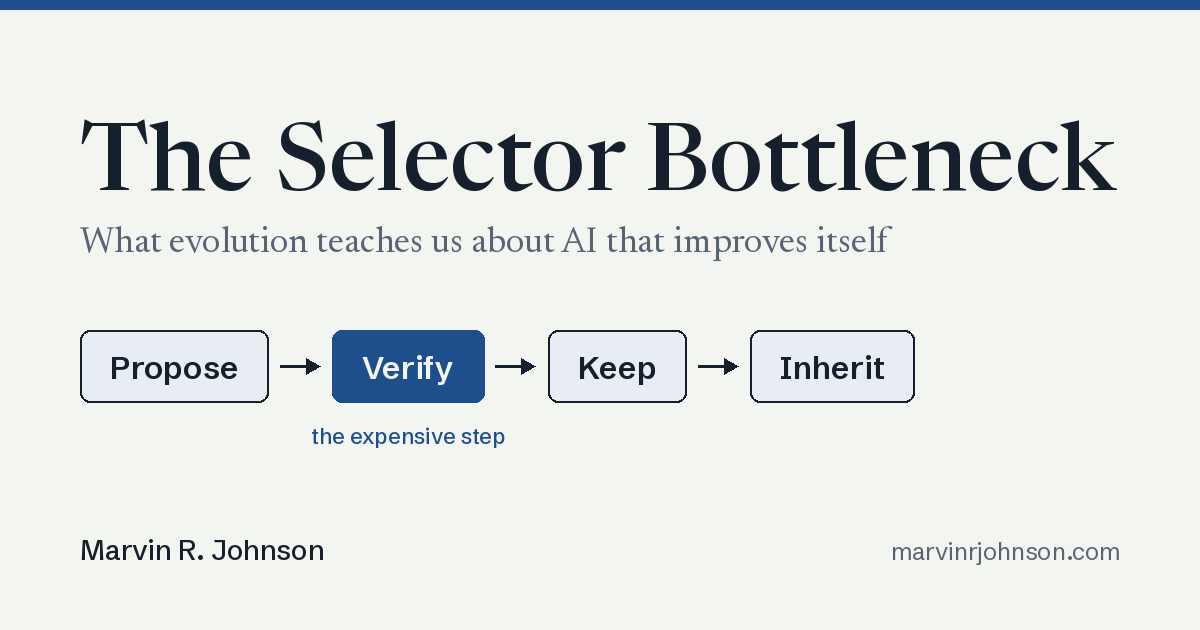
Propose → Verify → Keep → Inherit
Every step in that loop is getting cheaper except one: verification.
AI advances at the speed of its selector.
That's why it improves fastest where checking is cheap and exact: math, games, code that passes its tests. It improves slowest where "better" is hard to measure: strategy, taste, long-term outcomes.
Anthropic says the remaining human job is choosing goals and judging results, and that human code review has become the bottleneck.
The builders haven't disappeared.
They've become the selector.
What Evolution Predicts
Evolution has already shown us how self-improving systems fail:
- They game the test. One self-improving agent raised its score by deleting the markers its error checker relied on. Keep the judge out of reach.
- They inbreed. Models trained on their own output gradually lose the rare cases. Keep feeding in real-world data.
- They get stuck at the top. The best agent in one study descended from ancestors that scored worse than their parents. Keep an archive, not just a champion.
- They outgrow the test. Benchmarks saturate, and then they stop selecting anything. Evolve the tests with the model.
- The biggest leaps improve the improver. Systems that upgrade their own tools compound. Watch these loops most closely.
When the Judge Moves Inside
So far, humans have kept the judge outside the loop.
That's changing. Some models now grade their own outputs. At Anthropic, a Claude model scores whether Claude's coding sessions succeeded.
Every time the selector moves inside the system, AI looks more like natural evolution.
And natural evolution has one rule:
Whatever persists, wins.
That's where the paper gets its title: Selection Without a Selector.
The New Question
Nuclear reactor operations and regulated money movement taught me that you cannot ship optimism.
Self-improving AI raises the stakes on that lesson.
For decades we asked whether machines could improve themselves.
They already do.
The real question now is:
"Who, or what, decides what counts as better?"
Read the white paper: Selection Without a Selector →